
Narrative Systems
The hidden interpretive systems that drive organizational performance
Every organization has a hidden layer of meaning beneath its formal structure. People move through that layer every day, interpreting its signals, adapting to its consequences, and learning what kind of reality the organization expects them to inhabit.
That layer is the narrative system — the interpretive field that quietly shapes behavior, performance, trust, and execution.
What Is a Narrative System?
Before narrative becomes organizational, it is personal.
THOUGHT EXPERIMENT
✦
Close your eyes and try to become still for one full minute. Almost immediately, you will notice that the mind keeps moving. Words arise. Images appear. Memories surface. Predictions form. Old conversations return. Future possibilities begin arranging themselves before you have consciously chosen them.
✦
That current is narrative. It is the mind assigning meaning as experience unfolds.
Narrative tells a person what a silence means, what a setback proves, what a risk may expose, what a conflict threatens, and what a future might require. It does not merely comment on experience. It helps organize experience. It shapes what we notice, what we fear, what we attempt, how long we persist, what we avoid, and what kind of action feels possible.
The same dynamic exists inside organizations.
When people repeatedly gather, interact, observe one another, and respond to shared conditions, their individual narratives begin to meet the signals around them. Leadership decisions, incentives, rituals, silences, stories, pressures, habits, and repeated experiences begin forming a shared interpretive layer. Over time, that layer becomes larger than any one person’s view.
A narrative system has formed.
A narrative system is the shared field of meaning through which people interpret the organization, understand what matters, decide what is safe or risky, and determine what kind of behavior makes sense. It is not usually designed intentionally. It emerges through repetition.
What happens inside a single human mind happens at scale inside an organization. The organization develops the equivalent of an inner narrative: a living interpretive system that filters events, assigns meaning, preserves memory, reinforces expectations, and shapes behavior.
This is why the narrative system is one of the deepest performance drivers in any organization. It does not merely influence what people say about the organization. It shapes how people experience the organization — and therefore how much trust, candor, energy, judgment, ownership, and commitment the organization is able to access, direct, and convert into results.

How Narrative Systems Form
Narrative systems do not appear all at once. They form through a repeating sequence of interaction, interpretation, reinforcement, and behavior.
01

Repeated Interaction
People gather, work, observe, respond, and adjust.
02

Shared Interpretation
They form common explanations for what events mean.
03
Reinforced Signals
People learn from communications, rituals, and consequences.
04

Behavioral Patterning
Over time, the system produces predictable behavior.
THE HIDDEN CURRICULUM
Once formed, a narrative system becomes the organization’s hidden curriculum. It teaches people what is valued, what is safe, what is rewarded, and what is treated as real — not through formal statements alone, but through repeated experience.
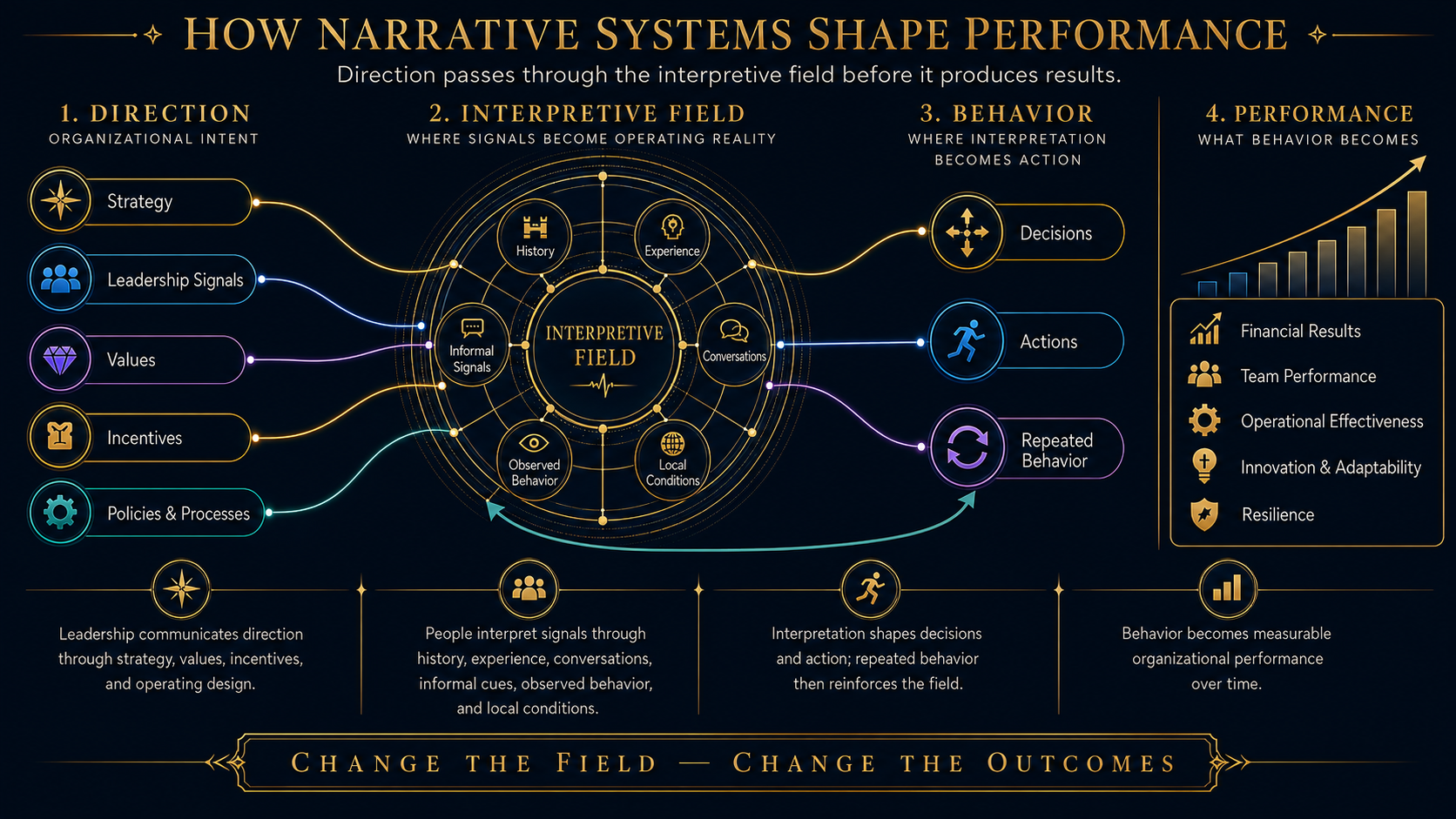
How Narrative Systems Shape Performance
Direction does not become performance directly. It passes through interpretation.
Strategy, structure, metrics, incentives, and leadership communication never enter neutral space. They enter an existing field of expectation, trust, memory, pressure, and prior experience. That field shapes how direction is received, how risk is assessed, how information is interpreted, and how effort is allocated.
When interpretation is coherent, priorities become clearer and more human capacity reaches execution. When it is not, hesitation, guarded communication, local optimization, and appearance management absorb energy before it can become performance.
From Decoherence to Coherence
Every viable organization begins with minimum viable coherence—not perfect or permanent alignment, but enough shared interpretation to coordinate action, create value, and survive. Decoherence begins when growth, pressure, or complexity weaken the relationships among leadership intent, transmitted signals, lived experience, and rewarded behavior.
Narrative Decoherence
Narrative decoherence is the progressive loss of alignment among the signals, interpretations, expectations, and consequences that once allowed an organization to act as a coherent whole.
It rarely appears all at once. It accumulates as growth, leadership turnover, competing priorities, exceptions, pressure, organizational memory, or local adaptation gradually weaken the relationships that once connected direction to behavior.
The organization may continue operating—and may even remain profitable—but its members increasingly learn from different realities. Priorities require constant decoding. Local interpretations multiply. As more available capacity is absorbed by uncertainty management, guarded communication, or local adaptation, performance drag increases.

Decoherent Field
Signals conflict. Interpretations diverge. Energy disperses. Capacity is redirected toward decoding and adaptation.

Coherent Field
Signals align. Interpretation converges. Energy is directed. Capacity is translated into coordinated action.
Restored Coherence
Coherence is restored when leadership intent, transmitted signals, shared interpretation, and rewarded behavior once again reinforce the same operating reality.
This does not require uniformity, total agreement, or the elimination of local judgment. It requires sufficient alignment for people to understand what matters, interpret decisions with less friction, and coordinate action under pressure.
In a coherent narrative system, energy moves toward contribution rather than decoding. Information travels more directly, judgment becomes more confident, and a greater share of available human capacity is translated into disciplined execution and measurable performance.
Decoherence is not the absence of order.
It is the weakening of the relationships that once made coordinated action possible.
Organizations become what their people are repeatedly taught to believe is possible.
Every organization is already producing a narrative system.
It teaches people what to trust, what to protect, what to attempt, what to avoid,
and what kind of contribution makes sense.
The work of leadership is to make that hidden system visible,
bring its signals into coherence, and create the conditions under which
human capacity can become sustained performance.

Narrative Systems ArchitectureTM for leaders navigating performance, trust, accountability and organizational drift.
Explore
© Copyright 2026 Devavani LLC All rights reserved
Narrative Systems Architecture™ is a trademark of Devavani LLC
|