Narrative Systems ArchitectureTM emerged from decades spent studying how language, interpretation, signals, institutions, and lived experience shape what human beings ultimately do.
Devavani was founded to formalize that body of work—and give leaders a disciplined way to see, map, and realign the hidden systems through which organizational reality becomes behavior and performance.
JON MAYNELLFOUNDER, DEVAVANICREATOR, NARRATIVE SYSTEMS ARCHITECTURE
THE PATTERN BEFORE THE FRAMEWORK
One Pattern, Across Many Worlds.
Narrative Systems Architecture did not begin as a theory in search of an application. It emerged from a pattern that kept revealing itself across otherwise unrelated worlds.
In music and performance. Across cultures and institutions. In finance, emerging technology, analytics, leadership, and organizational life. Again and again, the visible structure told only part of the story. Beneath it was another system—formed through interpretation, reinforced through interaction, and made consequential through behavior.
The environments changed. The pattern did not.
Over time, what first appeared to be a recurring human dynamic began to reveal something more: the attributes of both a field and a system. Shared interpretations moved through groups, accumulated force, shaped what people perceived as possible, and produced remarkably patterned behavior.
That recognition would eventually become Narrative Systems Architecture.
CONVERGING VANTAGE POINTS
Different Worlds. The Same Hidden Architecture.
Before the pattern had a name, each arena exposed a different dimension of it. Taken together, they revealed that action does not flow directly from information, authority, or structure. It is mediated by the shared field of interpretation through which people decide what is true, what matters, and what behavior makes sense.
CULTURE
Across Cultures and Institutions
The same language, events, and structures can produce radically
different realities when interpreted through different shared frames.
EMERGENT INSIGHTInterpretation is systemic.
FIELD NOTE+
PERFORMANCE
Music, Ensemble, and Coordination
Performance made coherence immediately perceptible: distinct human
agents coordinating timing, attention, intention, and response until
the whole becomes more capable than any part.
EMERGENT INSIGHTCoherence can be experienced before it is measured.
FIELD NOTE+
FINANCE
Confidence and Human Decision-Making
Financial behavior exposed how confidence, fear, identity, and
perceived possibility can govern action more powerfully than
information alone.
Advanced technology exposed the distance between superior capability
and institutional acceptance. Better information did not guarantee
recognition, trust, or adoption.
EMERGENT INSIGHTSuperior information does not ensure movement.
FIELD NOTE+
ANALYTICS
Measurement and the Invisible System
Analytics demonstrated what measurement could reveal—and what it
could miss. Data could describe outcomes precisely while leaving the
interpretive system producing them largely unseen.
Across organizations, formal design repeatedly diverged from lived
reality. What leaders said mattered and what the system rewarded were
often two different things.
EMERGENT INSIGHT
The organization beneath the organization governs performance.
FIELD NOTE+
THE PATTERN CONVERGESNarrative Systems Architecture
Observation Becomes Architecture
FIELD NOTE 01CULTURE
EMERGENT INSIGHT
Moving between Germany and the United States made cultural differences
unusually visible. Language, history, authority, and responsibility
carried different meanings in each society. But the more consequential
observation emerged within Germany itself—in the generational conflict
unfolding inside its tightly structured families.
By the 1970s, many younger Germans were confronting the history of the
Third Reich with questions their parents’ generation often preferred not
to revisit. They wanted to know how the atrocities had been allowed to
happen, why more people had not resisted, and why postwar Germany had
retained so many of the same institutions—and, in some cases, the same
people in positions of influence.
The parents’ narrative emphasized survival, reconstruction, order, and
the restoration of ordinary life. Their children increasingly interpreted
that desire for normalcy as silence, avoidance, or even continuing
complicity. The younger generation began constructing a counter-narrative
around accountability, resistance, and the need to make Germany
fundamentally different from what it had been.
The rise of the Baader-Meinhof Group and the Red Army Faction brought
these opposing interpretations into still sharper conflict. Sympathy
among some young Germans persisted even as protest escalated from symbolic
destruction to kidnapping and killing, while their parents reacted with
horror.
Yet these opposing narrative systems continued to inhabit the same
households.
Germany’s family institution—highly structured around education, music,
fitness, responsibility, schedules, and shared life—proved more durable
than either political narrative. Parents and children could collide over
history, legitimacy, and violence while continuing to function together
in nearly every other domain.
What became visible was not merely cultural difference. It was the nested
nature of narrative systems: opposing interpretations could govern one
dimension of behavior while a deeper, older system continued to organize
the whole.
Professional performance in the opera houses of Germany, Austria, and
Switzerland offered an unusually concentrated view of human coordination.
A score can define the notes. A conductor can establish tempo and
intention. Rehearsal can assign entrances, movements, and responsibilities.
Yet none of these elements alone produces a coherent performance.
Coherence emerges when distinct human agents begin continuously
interpreting and responding to one another: a singer adjusting to the
orchestra, the orchestra responding to the conductor, performers sensing
timing and intention across the stage. Each individual remains distinct,
but attention becomes relational and the ensemble begins functioning as
a whole.
The difference between technically correct execution and a unified
performance can be immediately felt—even before it can be adequately
explained or measured.
Performance demonstrated that coherence is not sameness, obedience, or
centralized control. It is coordinated distinction within a sufficiently
shared field of interpretation.
Mortgage lending repeatedly demonstrated that information does not
determine behavior by itself.
Two people could encounter substantially similar financial conditions
and respond in opposite ways. One perceived possibility; another perceived
danger. One moved confidently; another became immobilized. The difference
was rarely contained in the numbers alone.
Financial information became consequential only after it was interpreted
through confidence, fear, identity, institutional trust, prior experience,
and the future a person believed was available to them. Reframing the same
numbers within a clearer and more meaningful structure could therefore
change behavior without changing the underlying facts.
This exposed the limitation of purely informational explanations. People
do not simply receive data, calculate rationally, and act. They construct
an interpretation of their conditions—and then behave in a manner that
appears reasonable inside that interpretation.
The operative variable was not information alone. It was what the
information had come to mean.
Work surrounding small unmanned aerial systems exposed a recurring problem
in technological adoption: institutions often struggle to recognize
capabilities that do not fit their existing conceptual categories.
The technology could be technically credible and operationally valuable,
yet remain difficult to evaluate because decision-makers were interpreting
it through models designed for different systems, missions, and scales.
The creation of the term PRISTA—Proximate Reconnaissance,
Intelligence, Surveillance, and Target Acquisition—was an effort
to provide a more accurate conceptual frame. The language was not merely
promotional. It gave the institution a way to perceive a distinct
operational capability that existing terminology had obscured.
This experience demonstrated that superior technology does not move through
an institution on technical merit alone. Before people can evaluate
something unfamiliar, they must possess a narrative and conceptual
structure capable of making it intelligible.
An institution cannot meaningfully respond to what its existing language
prevents it from seeing.
Business intelligence made organizational behavior increasingly visible.
Patterns that had once been anecdotal could be tracked, compared, and
presented with precision. Performance could be measured across people,
teams, locations, and time.
But measurement also exposed its own boundary.
A dashboard could show that performance had changed without explaining
why the people inside the system considered their behavior sensible. It
could identify a recurring outcome while leaving invisible the assumptions,
informal signals, local incentives, and shared interpretations producing it.
Data also became part of the system it measured. What leaders selected,
displayed, discussed, and rewarded communicated what the organization
considered important. The measurement was therefore not merely descriptive;
it could alter attention and behavior.
Analytics revealed the signals. It could not, by itself, explain the
interpretive field in which those signals acquired meaning. Understanding
the system required both.
Across organizational strategy and operations, formal design repeatedly
diverged from lived reality.
Leadership could articulate a clear priority, publish a strategy,
restructure responsibilities, or announce a new standard. Yet daily
behavior continued to respond to a different collection of signals: what
received attention, what escaped consequence, what earned status, what
protected belonging, and what the organization repeatedly rewarded in
practice.
When those signals contradicted the formal narrative, employees were not
necessarily confused or resistant. They were often interpreting the
operating environment accurately. The system had taught them which
statements were ceremonial and which conditions actually governed success.
This explained why apparently sensible interventions so often failed to
produce durable change. The visible organization had been modified, but
the interpretive system beneath it remained intact.
Formal authority could direct behavior temporarily. The organization’s
lived narrative determined what behavior remained rational over time.
When the Pattern Became a System
NSA treats narrative coherence not simply as an impression, but as an observable—and increasingly measurable—condition. Its emerging mathematical models are designed to help weight signals, anticipate directional effects, improve the predictability of vector engagements, and evaluate whether coherence actually increased after the work was done.
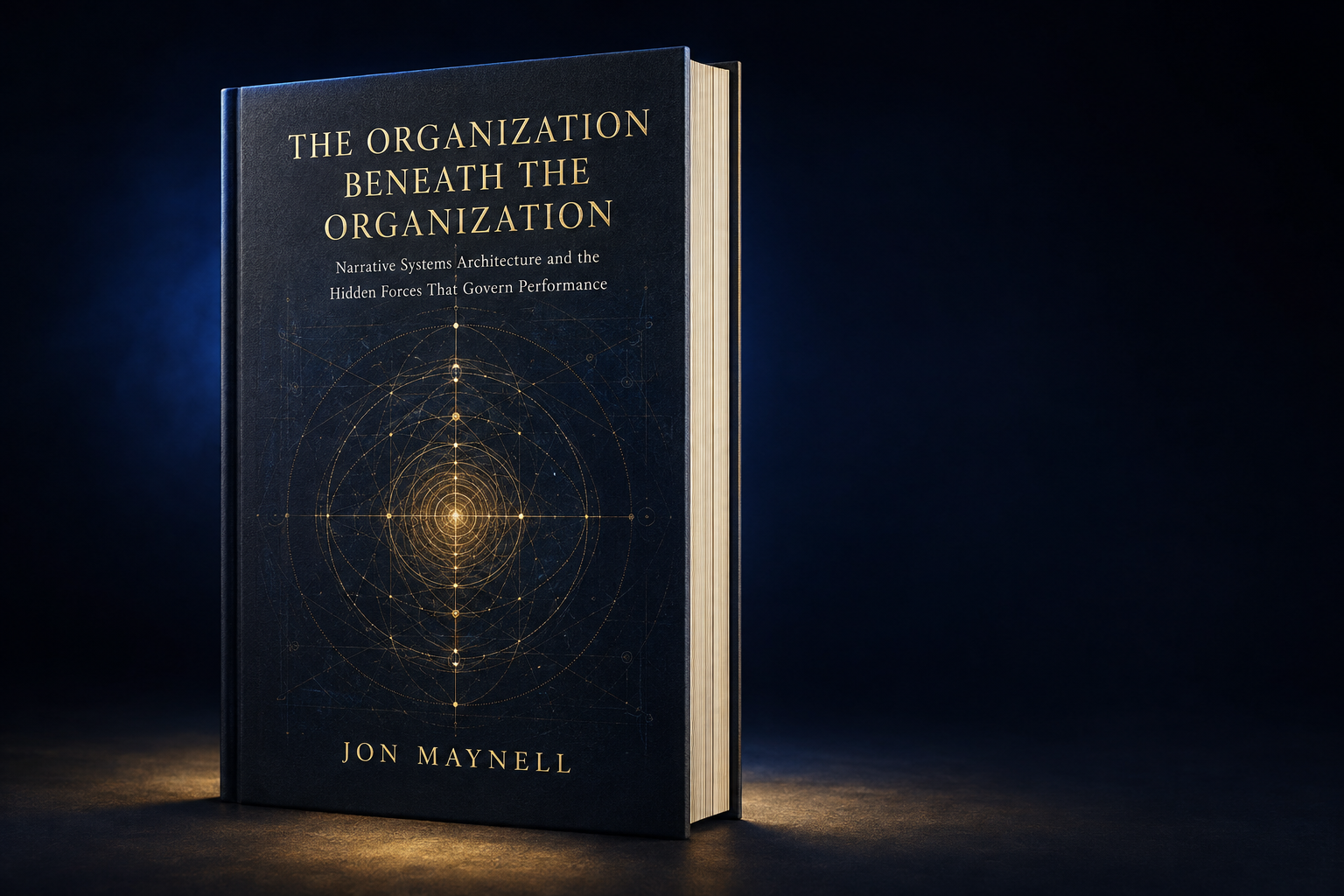
FORTHCOMING BOOKBY JON MAYNELL
The OrganizationBeneath the Organization
Narrative Systems Architecture and the Hidden Forces That Govern Performance
Expanding the framework introduced in Devavani’s white paper, the
forthcoming book takes a deeper look at how hidden interpretive systems
form, drift, and shape organizational behavior.
It explores how leaders can recognize the organization beneath the formal
organization—the living system of signals, stories, incentives,
expectations, and repeated experiences that ultimately determines how
people trust, decide, adapt, and perform.
THE FRAMEWORK, FULLY DEVELOPED
Narrative Systems ArchitectureTM for leaders navigating performance, trust, accountability and organizational drift.